Calculating test and quiz scores does not have to be complicated. Whether you are a teacher grading a classroom assessment or a student checking a practice test, an easy grader can make the process faster and more convenient. Instead of repeatedly working out percentages by hand, you can enter the number of questions and answers and quickly determine the final score.
Modern online Easy Grader tools can calculate percentages and, in many cases, convert those percentages into letter grades. Some also support different grading scales, making them useful for a variety of classrooms and educational systems.
In this guide, we will explain what an Easy Grader is, how it works, how to calculate grades manually, and when you may need a more advanced grade calculator.
What Is an Easy Grader?
An Easy Grader is a simple grading tool designed to calculate the score of a test, quiz, or other assessment. It generally uses the total number of questions and the number of correct or incorrect answers to determine a percentage.
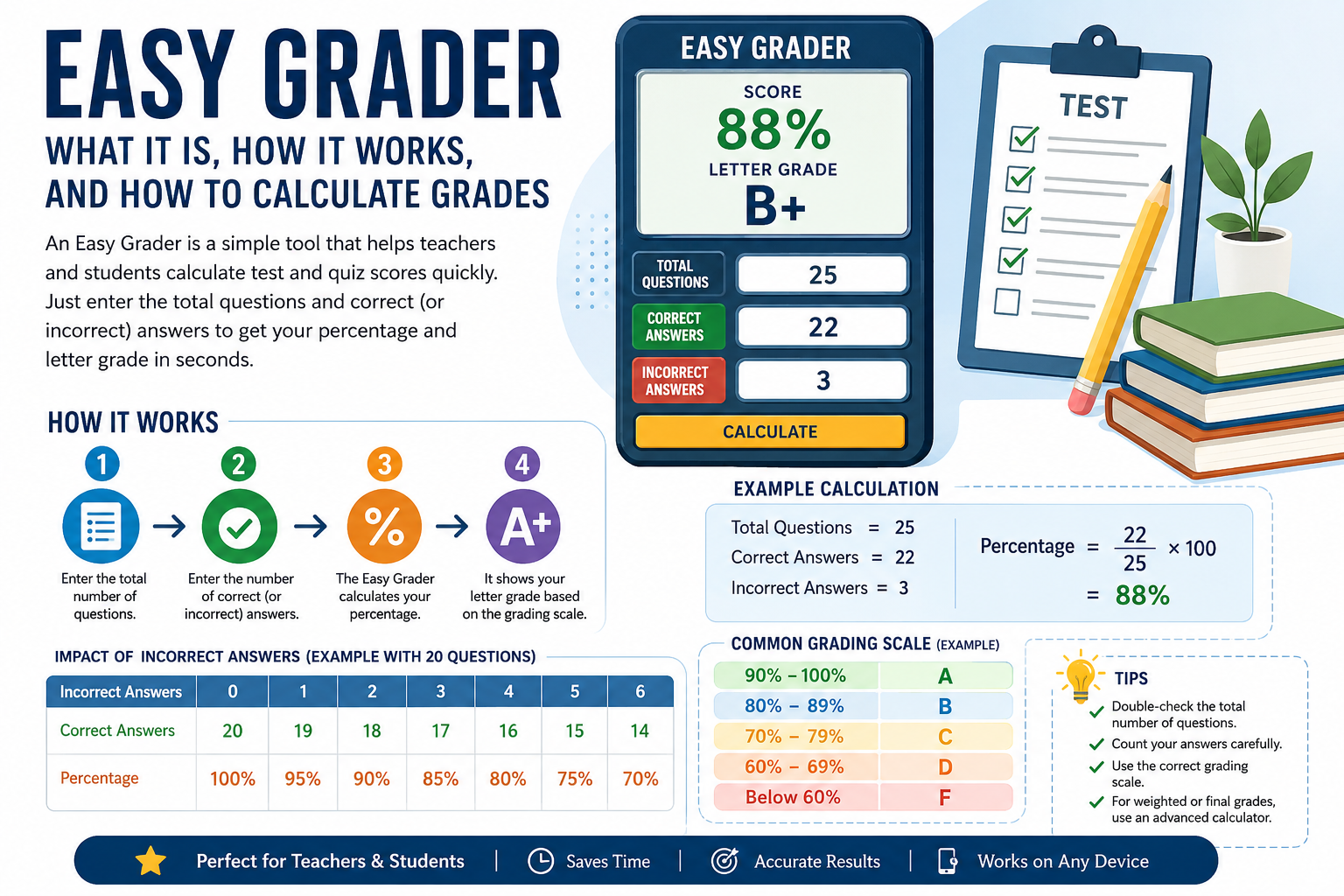
For example, imagine a test has 25 questions and a student answers 22 correctly. An Easy Grader can quickly determine that the student earned 88%.
Many digital Easy Grader tools go a step further by showing the corresponding letter grade. However, the letter grade depends on the grading scale used by the school, teacher, or institution.
Traditional Easy Graders were often available as physical grading charts or wheels. Digital versions provide the same basic function through a website or calculator, making the process easier to access from a computer, tablet, or smartphone.
How Does an Easy Grader Work?
The basic process behind an Easy Grader is straightforward. It determines how many questions were answered correctly and compares that number with the total number of questions.
The basic formula is:
Percentage = (Correct Answers ÷ Total Questions) × 100
For example, if a student answers 18 out of 20 questions correctly:
18 ÷ 20 × 100 = 90%
The resulting score is 90%.
If the tool also uses a letter-grade scale, it can then convert that percentage into a letter. Under one common grading scale, 90% may be an A, while 80% may be a B. However, grading policies differ, so the applicable scale should always be checked.
How to Use an Easy Grader
Using an Easy Grader usually requires only a few steps.
1. Enter the Total Number of Questions
Start by entering the total number of questions on the test or quiz. For example, if the assessment contains 50 questions, enter 50.
This number is important because the effect of each incorrect answer depends on the size of the test.
2. Enter the Correct or Incorrect Answers
Depending on the calculator, you may enter either the number of correct answers or the number of incorrect answers.
For a 50-question test with five incorrect answers, the student has 45 correct answers.
3. Calculate the Percentage
The calculator divides the number of correct answers by the total number of questions and multiplies the result by 100.
In this example:
45 ÷ 50 × 100 = 90%
The student’s test score is therefore 90%.
4. Check the Letter Grade
If the Easy Grader includes a grading scale, it may also display the corresponding letter grade. A common scale might classify 90–100% as an A, 80–89% as a B, and so on.
However, this should only be treated as a general example. Your teacher or school may use different thresholds.
Easy Grader Example
A simple example shows how quickly an Easy Grader can convert test results into percentages.
Suppose a quiz has 20 questions:
| Incorrect Answers | Correct Answers | Percentage |
| 0 | 20 | 100% |
| 1 | 19 | 95% |
| 2 | 18 | 90% |
| 3 | 17 | 85% |
| 4 | 16 | 80% |
| 5 | 15 | 75% |
This example also demonstrates why the number of questions matters. On a 20-question quiz, every missed question changes the score by five percentage points.
On a 100-question test, however, each missed question represents only one percentage point.
Easy Grader vs. Manual Grade Calculation
You can calculate a test grade manually with basic arithmetic, but an Easy Grader can make repetitive calculations quicker.
With manual calculation, you need to count the correct answers, divide them by the total number of questions, and multiply by 100. This is easy for one test but can become repetitive when a teacher has dozens of papers to grade.
An Easy Grader reduces this work by performing the calculation automatically. This can be especially useful when grading multiple-choice tests or quizzes with a large number of questions.
The main advantage is not that the mathematics is difficult. Rather, the tool saves time and reduces the chance of simple arithmetic mistakes.
What Can You Calculate With an Easy Grader?
An Easy Grader is primarily useful for assessments where the score is based on the number of questions answered correctly.
Test Grades
Teachers can use an Easy Grader to calculate scores for classroom tests, practice exams, and multiple-choice assessments.
Quiz Grades
Short quizzes can also be scored quickly. A teacher can enter the total number of questions and the student’s incorrect answers to determine the percentage.
Percentage Grades
An Easy Grader can convert raw scores into percentages. This makes it easier to understand how a score compares with the total possible score.
Letter Grades
Some Easy Grader tools can convert percentages into letter grades. The exact result depends on the grading scale being used.
Different Test Sizes
The same basic process works for assessments with different numbers of questions. You can calculate a score for a 10-question quiz, a 50-question test, or a 100-question examination.
Easy Grader for Teachers
Teachers are one of the main groups that can benefit from an Easy Grader. Grading assessments can involve repetitive calculations, especially when many students take the same test.
An Easy Grader can help teachers:
- Calculate scores quickly
- Reduce repetitive arithmetic
- Check calculations
- Convert raw scores into percentages
- Apply a selected grading scale
- Save time when handling multiple assessments
Digital tools can also be convenient because they are generally accessible from common devices. Instead of keeping a physical grading chart nearby, teachers can use an online calculator whenever they need it.
However, an Easy Grader works best for straightforward assessments. Complex grading systems involving assignments, projects, participation, and different category weights may require a more advanced calculator.
Easy Grader for Students
Students can also use an Easy Grader to understand their performance.
For example, after completing a practice test, a student can enter the number of questions answered correctly and immediately see the percentage. This can help students identify areas where they need additional practice.
Students can also use the tool to understand how individual mistakes affect a test score. For instance, missing two questions on a 20-question quiz produces a different percentage than missing two questions on a 100-question exam.
An important point is that a self-calculated result may not always match the official course grade. Teachers may use weighted assignments, bonus points, penalties, curves, or other grading rules.
Easy Grader and Different Grading Scales
One of the most important things to understand about an Easy Grader is that percentages and letter grades are not always the same everywhere.
A common grading scale might look like this:
- 90–100%: A
- 80–89%: B
- 70–79%: C
- 60–69%: D
- Below 60%: F
But another school or teacher may use different boundaries. Some grading systems also include plus and minus grades, such as A-, B+, or C+.
Therefore, the percentage calculated by an Easy Grader is generally more universal than the letter grade. Always check the grading policy that applies to the particular class or assessment.
Easy Grader vs. Other Grade Calculators
Not every grade calculator performs the same job.
An Easy Grader is generally designed for quickly calculating the score of a test or quiz based on correct and incorrect answers.
A percentage calculator can perform broader percentage calculations and may not be specifically designed for classroom grading.
A weighted grade calculator is more useful when assignments have different weights. For example, homework might count for 20% of a course grade while exams count for 50%.
A final grade calculator can help determine what score a student needs on a future exam to reach a desired overall course grade.
Understanding these differences helps you choose the right tool for the calculation you need.
Common Easy Grader Mistakes to Avoid
Even a simple grading tool can produce an incorrect result if the information entered is wrong.
One common mistake is entering the wrong total number of questions. Another is incorrectly counting the number of correct or incorrect answers.
Users should also make sure they are applying the correct grading scale. A percentage may be accurate while the displayed letter grade is inappropriate for a particular school.
Other issues can include bonus points, partial credit, penalties, and weighted assessments. A basic Easy Grader may not account for these factors.
For complicated grading systems, it is better to use a calculator specifically designed for weighted or final grades.
Benefits of Using an Easy Grader
An Easy Grader offers several practical advantages.
Speed: It can calculate a test score almost immediately.
Simplicity: Most tools require only a few basic inputs.
Convenience: Online versions can be accessed from computers and mobile devices.
Fewer arithmetic mistakes: Automatic calculations reduce repetitive manual work.
Easy score checking: Teachers and students can quickly verify a percentage.
Useful for different assessments: The same basic process can be used for quizzes, tests, and practice exams.
For teachers who grade many similar assessments, these small time savings can become significant.
Tips for Getting Accurate Results
To get the best results from an Easy Grader, always double-check the information before calculating the score.
First, confirm the total number of questions. Next, carefully count the correct or incorrect answers. If the tool allows you to select a grading scale, make sure it matches the policy used by your teacher or school.
You should also determine whether the assessment includes bonus points, penalties, partial credit, or other special rules. If it does, a basic Easy Grader may not be sufficient.
Finally, remember that an Easy Grader calculates the information you provide. It cannot determine whether an answer is correct or understand a teacher’s unique grading policy unless those rules are built into the tool.
Frequently Asked Questions About Easy Grader
What is an Easy Grader?
An Easy Grader is a tool that calculates test or quiz scores based on the number of correct and incorrect answers. Many digital versions also show the percentage and corresponding letter grade.
How do I calculate my grade from the number of questions I missed?
Subtract the number of incorrect answers from the total questions to find the correct answers. Then divide the correct answers by the total and multiply by 100.
Can an Easy Grader calculate letter grades?
Many Easy Grader tools can convert percentages into letter grades, but the result depends on the grading scale selected or used by the tool.
Can students use an Easy Grader?
Yes. Students can use one to check practice tests, estimate assessment scores, and understand how missed questions affect their percentages.
Can an Easy Grader calculate weighted grades?
A basic Easy Grader usually focuses on individual test or quiz scores. Weighted course grades require a calculator that supports different assignment categories and weights.
Conclusion
An easy grader provides a simple way to calculate test and quiz scores without repeatedly performing the same calculations by hand. By using the number of correct answers and total questions, it can quickly determine a percentage and, when supported, a letter grade.
The tool is useful for both teachers and students, particularly when dealing with straightforward assessments. However, users should remember that grading scales vary, and more complicated course calculations may require a weighted or final grade calculator.
For quick test scoring, an Easy Grader can save time, simplify the process, and make it easier to understand assessment results.