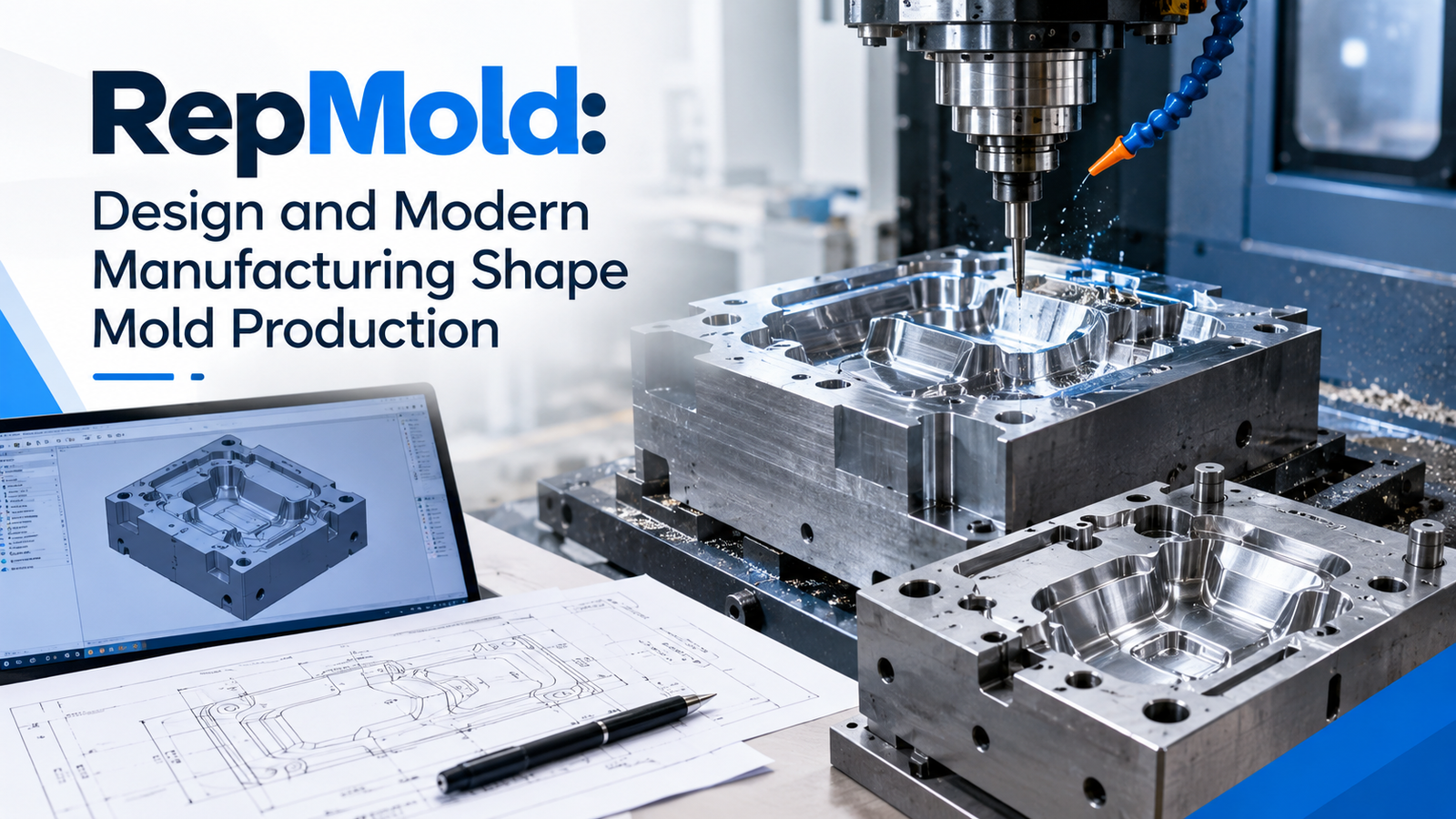
RepMold is generally described as an approach to mold development that combines digital design with manufacturing techniques such as precision machining and additive manufacturing. Depending on the application, the process may involve designing a new mold, reproducing an existing component, creating prototype tooling, or modifying a mold to meet changing production requirements.
The basic idea is to use digital information to guide the creation, adjustment, and inspection of physical tooling. Instead of relying entirely on manual measurements and repeated physical modifications, manufacturers can use digital models, engineering software, and automated equipment to plan and execute important stages of the work.
For example, a manufacturer developing a plastic enclosure might create a three-dimensional CAD model, design a corresponding mold, machine the tooling, and test sample parts before beginning larger-scale production. If the first samples reveal dimensional problems, engineers can revise the digital design and manufacture updated tooling or inserts.
Several established technologies support this type of workflow:
- CAD software creates and modifies digital product and mold designs.
- CNC machining removes material from metal or other suitable stock to produce precise tooling.
- 3D printing builds objects layer by layer and can create prototype molds, patterns, inserts, or certain production tools.
- Reverse engineering reconstructs a digital model from an existing physical component.
- Inspection and simulation tools help evaluate dimensions and identify potential design problems.
RepMold should not automatically be treated as a particular machine, patented invention, software platform, or standardized manufacturing process. It is more accurate to understand the term through the manufacturing methods associated with it unless stronger documentation establishes a specific proprietary meaning.
How Does RepMold Work?
A workflow can involve several stages, from initial planning to final quality inspection. The precise sequence depends on the part being manufactured, the selected mold material, the production volume, and the required level of accuracy.
1. Product Design and Requirement Analysis
The process begins by defining what the mold must produce and the conditions under which it will operate.
Engineers consider the part’s dimensions, geometry, material, surface finish, tolerances, and expected production quantity. They also identify operating conditions such as heat, pressure, chemical exposure, and mechanical stress.
These requirements influence every later decision. A mold intended for a handful of prototype parts may need different tooling from one expected to produce hundreds of thousands of components.
Manufacturers should also establish acceptable defect levels, inspection requirements, and expected tool life. Defining these details early helps prevent unnecessary design changes and reduces the risk of selecting unsuitable materials or equipment.
2. Digital Modeling and 3D Scanning in RepMold
Once the requirements are understood, engineers create a digital model using CAD software or reconstruct one from an existing object.
When an original component is available, 3D scanning can capture its shape and dimensions. The resulting data can help engineers recreate a digital surface model, compare a worn part with its intended geometry, or develop replacement tooling.
Scanning does not automatically produce a manufacturing-ready design. Engineers may need to clean the scan data, correct missing surfaces, establish dimensions, and account for features that cannot be captured accurately.
For example, if an old mold has worn edges or damaged cavities, copying its current surface without correction could reproduce those defects. Reverse engineering therefore requires engineering judgment, not simply copying the scanned geometry.
3. Mold Design and Engineering
In the RepMold process, engineers use digital models to design precise molds that meet production requirements. Designs may include gates, vents, cooling channels, and ejector mechanisms while accounting for material shrinkage. Digital mold design helps identify potential defects, improve accuracy, reduce waste, and simplify future design revisions.
4. Simulation and Design Validation
Mold simulation software can help predict how a material may flow, cool, and solidify inside a mold. Depending on the process and available software, engineers may investigate filling patterns, air traps, weld lines, cooling performance, sink marks, and warping.
The purpose is to identify potential problems before committing to physical tooling or production trials.
Simulation results depend on the accuracy of the design, material properties, process settings, and assumptions used in the model. A simulation is therefore a decision-support tool rather than a guarantee that a mold will work perfectly.
For complex or safety-critical components, physical testing and engineering validation remain essential.
5. Mold Creation Through CNC Machining or 3D Printing
After the design has been reviewed, the mold or its components can be manufactured using a suitable process.
CNC machining uses programmed cutting tools to remove material from blocks of aluminum, steel, or other machinable materials. It is widely used for precision mold cavities, cores, inserts, and other tooling components.
Three-dimensional printing creates objects layer by layer. Depending on the technology and material, it can be used to produce prototype molds, patterns, specialized inserts, and certain tools for limited production.
Some projects combine these approaches. For instance, a printed component may serve as a pattern for casting, while CNC machining creates the final precision surfaces. A hybrid approach can also use a machined mold body with replaceable printed or machined inserts.
The best option depends on required accuracy, surface finish, operating temperature, pressure, tool life, and production volume.
6. Finishing, Inspection, and Quality Control
Manufacturing a mold is not the end of the process. Its working surfaces and dimensions must meet the relevant engineering requirements.
Finishing operations may include polishing, grinding, sealing, coating, heat treatment, or additional machining. The exact operations depend on the mold material and intended use.
Inspection can involve dimensional measurement, surface checks, alignment verification, and examination of critical features. Manufacturers may use coordinate measuring machines, optical inspection systems, gauges, or other appropriate equipment.
These checks help confirm that the mold matches its design and is suitable for testing.
Key Technologies Behind RepMold
RepMold-related manufacturing draws on several established technologies. Not every project requires all of them, and their availability does not prove that a particular RepMold provider offers every capability.
Computer-Aided Design (CAD)
CAD software allows engineers to create, modify, and document three-dimensional models. In mold development, it supports cavity design, parting surfaces, dimensional adjustments, and the preparation of manufacturing data.
One major advantage is the ability to revise a design without rebuilding the entire model from scratch. Engineers can also share digital files with machining, inspection, and production teams.
CNC Machining and Precision Tooling
CNC machining translates programmed instructions into controlled cutting movements. It is commonly used to produce detailed mold surfaces and components from metals and other suitable materials.
Its strengths include precision, repeatability, and the ability to work with durable tooling materials. However, machining costs, setup time, tool access, and part complexity can influence whether it is the best choice for a particular project.
3D Printing and Additive Manufacturing in RepMold
Additive manufacturing creates objects by building material layer by layer. It can support rapid prototypes, casting patterns, specialized tooling, and some low-volume production applications.
Its main attraction is design flexibility. Complex geometries can sometimes be produced with less material removal than conventional machining.
Nevertheless, printed tooling may have limitations involving surface finish, strength, heat resistance, dimensional stability, or service life. Some printed components require substantial post-processing before they can be used in manufacturing.
Reverse Engineering and Digital Scanning
Reverse engineering helps reconstruct a design from a physical object when original drawings or CAD files are unavailable.
It can be useful for repairing older molds, replacing discontinued components, or documenting legacy equipment. The quality of the final model depends on scan accuracy, measurement methods, engineering interpretation, and verification against the intended specifications.
Mold Simulation and Digital Inspection
Simulation evaluates predicted manufacturing behavior, while digital inspection compares actual parts or tooling with their intended geometry.
Together, these tools can help identify potential problems earlier and make quality checks more systematic. However, neither removes the need for appropriate physical validation.
Automation and Artificial Intelligence
Automation can control repetitive manufacturing operations, collect machine data, and support consistent production. Artificial intelligence is also being explored and used in broader manufacturing applications, including defect detection, predictive maintenance, and process optimization.
However, general advances in AI do not establish that every RepMold process uses artificial intelligence. A provider claiming AI-powered capabilities should explain which system is used, what it does, and how its performance is demonstrated.
Main Applications of RepMold
Rapid Prototyping and Product Development
Product developers often need physical samples to evaluate dimensions, fit, usability, and appearance before launching full production.
Digital mold design and rapid tooling can help teams move from a concept to a testable component. If a design changes, engineers may update the model and produce revised tooling or inserts.
This approach is especially useful when a business wants to evaluate a design before investing in expensive production tooling.
Custom Mold Design and Small-Batch Manufacturing
Some products are made in limited quantities or require customer-specific features. In these situations, flexible tooling can be more practical than investing immediately in a highly durable, high-volume mold.
Examples include customized enclosures, specialized industrial parts, short production runs, and limited-edition products.
The economics depend on the total project cost, setup requirements, material selection, and number of acceptable parts produced.
Mold Repair, Replication, and Replacement
RepMold can support mold replication when original drawings are missing, spare tooling is unavailable, or an existing mold is worn out. Scanning and reverse engineering help reconstruct its geometry, allowing engineers to restore damaged surfaces, improve features, and correct design weaknesses before manufacturing a replacement mold.
Automotive and Industrial Components
Automotive and industrial manufacturers use molds and tooling for numerous plastic, rubber, composite, and other components.
Digital design and rapid tooling can support early development, replacement parts, and selected low-volume applications. Components that must withstand demanding temperatures, pressures, or mechanical loads require suitable materials and rigorous validation.
Medical Devices and Healthcare Products
Certain medical products and housings can benefit from customized tooling and carefully controlled manufacturing workflows.
However, healthcare applications may involve strict requirements for material safety, cleanliness, traceability, dimensional accuracy, and regulatory compliance. A digital design or prototype alone does not establish that a product is safe or suitable for clinical use.
Consumer Products, Electronics, and Packaging
Manufacturers of consumer goods, electronic housings, containers, and packaging may use digital mold development to test designs and adjust product features.
For example, a business could revise a product enclosure to improve assembly or change a container’s geometry to suit a new package size. Flexible tooling can support these changes, provided the selected process meets the required finish, durability, and production rate.
Materials Used in RepMold-Related Manufacturing
Material selection affects the cost, accuracy, durability, and performance of a mold. There is no single material suitable for every application.
| Material | Common use or advantage | Main consideration |
| Aluminum | Prototype and selected production tooling; relatively easy to machine | Lower wear and heat resistance than many tool steels |
| Tool steel | Durable tooling for demanding applications | Higher machining and processing requirements |
| Printed polymers and resins | Prototypes and certain low-volume tools | Heat resistance, strength, and service life |
| Printed metals | Complex tooling components and specialized inserts | Equipment cost, post-processing, and validation |
| Silicone | Flexible molds for selected casting and replication applications | Limited suitability for high-temperature or high-pressure conditions |
| Composite and sand-based systems | Specialized molding and casting applications | Process-specific strength, finish, and dimensional limitations |
The correct choice depends on the molding material, operating conditions, expected output, required surface quality, and anticipated tool life. Engineers should evaluate the complete manufacturing process rather than choosing a material based on its purchase price alone.
Potential Benefits of RepMold
Faster Design Iterations
Digital models can be modified and shared without recreating every drawing manually. When a design change is relatively simple, this can shorten parts of the development process.
However, total project time also depends on manufacturing capacity, tooling complexity, material availability, finishing, and testing.
Earlier Detection of Design Problems
Simulation, CAD reviews, and digital inspection can reveal certain problems before they become expensive production issues.
Finding a potential interference, unsuitable draft angle, or cooling concern early may reduce rework. The effectiveness of these checks depends on the quality of the data and the expertise of the engineering team.
Flexible Prototyping and Customization of RepMold
Digital manufacturing methods can make it easier to test different product geometries, customize features, and develop replacement tooling.
This flexibility is valuable for products that are still changing or are manufactured in relatively small quantities.
Potential Tooling and Development Savings
Rapid tooling may reduce the initial investment required for some prototypes and limited production runs. It can also reduce the need for certain traditional tooling steps.
Nevertheless, digital equipment, specialist software, engineering labor, post-processing, and inspection all contribute to the final cost. A conventional mold may be more economical when producing large quantities of a stable design.
Improved Documentation and Repeatability
Digital files and inspection records make it easier to preserve manufacturing knowledge. Teams can use approved designs and process settings to support repeat orders or future repairs.
Repeatability still depends on material consistency, equipment condition, process control, and quality assurance.
Opportunities to Reduce Waste
Simulation and better planning may help reduce failed tooling attempts and defective parts. Additive manufacturing can also reduce material removal for suitable geometries.
The environmental benefit is not automatic. Electricity consumption, printed-material waste, failed builds, finishing operations, tool life, and end-of-life disposal should all be considered.
Limitations and Challenges of RepMold
Material and Temperature Restrictions
Not every tooling material can withstand the heat, pressure, chemical exposure, or mechanical loads of a given molding process.
A printed polymer tool might work for a limited prototype run but fail under conditions that a hardened steel mold can tolerate. Engineers must select materials based on actual operating requirements.
Mold Durability and Surface Finish
Some rapid tooling methods require additional polishing, coating, or machining to achieve the desired surface quality.
Tool wear and deformation can also affect dimensional consistency. If a mold is expected to produce a large number of parts, its expected service life becomes a major factor in the decision.
Equipment and Training Costs of RepMold
CAD software, CNC machines, additive manufacturing equipment, inspection systems, and specialist personnel can require substantial investment.
Outsourcing may reduce the need to purchase equipment, but manufacturers must still consider service charges, lead times, and the provider’s technical capabilities.
Simulation Accuracy and Physical Testing
Digital simulations rely on assumptions and input data. They may not fully represent every material variation, machine condition, or real-world production issue.
Physical samples and appropriate validation are necessary to confirm that the completed tooling meets its requirements.
Production Volume and Scalability
A technique that is economical for ten parts may not be the best option for producing hundreds of thousands.
High-volume manufacturing often benefits from durable tooling, optimized cycle times, and established production processes. The correct decision requires comparing total costs across the intended quantity.
Quality, Security, and Intellectual Property
CAD models, product scans, and manufacturing files can contain confidential business information. Organizations should use secure storage, access controls, backups, and version management.
Furthermore, possessing or scanning a physical object does not automatically grant permission to reproduce it commercially. Patents, design rights, copyrights, contracts, and other legal restrictions may apply, depending on the product and jurisdiction.
RepMold vs. Traditional Mold Manufacturing
The main difference is not necessarily the mold itself, but how digital tools and manufacturing methods are incorporated into the development process.
| Factor | Digital or rapid tooling approach | Traditional tooling approach |
| Design revisions | Digital changes can simplify selected revisions | Changes may require additional machining or tooling work |
| Initial investment | May be lower for certain prototypes and short runs | Can be higher for complex production tooling |
| Production volume | Often useful for prototypes and limited runs | Often suitable for stable, high-volume production |
| Material options | Depends on available printing and machining processes | Broad options for conventional tooling materials |
| Surface finish | May require additional finishing | Can achieve excellent finishes with appropriate processes |
| Tool life | Varies considerably by material and method | Hardened tooling can offer long service life |
| Best-fit application | Flexible development and selected low-volume needs | Repeated production at established specifications |
These categories overlap. Traditional mold manufacturers also use CAD, simulation, CNC machining, and automated inspection. Likewise, a digital workflow may produce a conventional steel mold rather than a temporary printed one.
The most suitable approach depends on the part, quantity, quality requirements, tooling budget, and expected production life—not simply whether a process is described as modern or traditional.
Is RepMold Suitable for Every Manufacturing Project?
RepMold-related methods can be useful, but suitability must be assessed against the project’s actual requirements.
For prototypes and small production runs, flexible tooling may reduce the commitment required before a design is finalized. For replacement parts, scanning and reverse engineering can help when original files are missing.
Before selecting a manufacturing provider or process, consider these questions:
- What material will the final part use?
- How many acceptable parts must be produced?
- What dimensional tolerances and surface finish are required?
- How much heat, pressure, and mechanical stress will the mold experience?
- What tool life is expected?
- Does the project require certification, traceability, or regulatory approval?
- What is the total cost, including design, manufacturing, finishing, testing, maintenance, and replacement?
A detailed quotation should explain the manufacturing method, material specifications, expected lead time, inspection plan, and any limitations. This makes it easier to compare alternatives fairly.
How to Evaluate a RepMold Service or Provider
If a company offers RepMold services, evaluate its actual capabilities rather than relying solely on the name.
Start by asking which processes it uses. Does it offer CAD design, 3D scanning, CNC machining, 3D printing, mold finishing, or only selected services? Request clear material specifications and information about achievable tolerances.
Next, review examples of comparable work. Sample parts, dimensional inspection reports, and documented project results are more useful than broad claims about speed or cost savings.
Ask for a breakdown of the quotation, including design work, tooling, finishing, testing, and any recurring charges. Confirm whether revisions are included and what happens if the first samples do not meet the agreed requirements.
It is also important to establish who owns the CAD files, who can access them, how confidential designs will be protected, and whether the provider has permission to manufacture the relevant product.
A reliable provider should explain the advantages and limitations of its chosen process and recommend alternatives when another method is more appropriate.
Conclusion
RepMold is a term associated with digital mold design, replication, and modern manufacturing approaches that may combine CAD, CNC machining, 3D printing, scanning, simulation, and quality inspection. These established technologies can support prototyping, customized tooling, mold replacement, and selected production applications.
Potential advantages include flexible design revisions, earlier problem detection, improved documentation, and reduced development effort for suitable projects. However, results depend on the materials, equipment, engineering requirements, production volume, and quality-control procedures involved.
RepMold should not automatically be considered a standardized process or a guaranteed lower-cost alternative to conventional mold manufacturing. Its value is best judged by the actual techniques used and the results they deliver. By comparing tooling options, verifying technical capabilities, and testing finished parts, manufacturers can select a process that balances cost, durability, accuracy, and production needs.