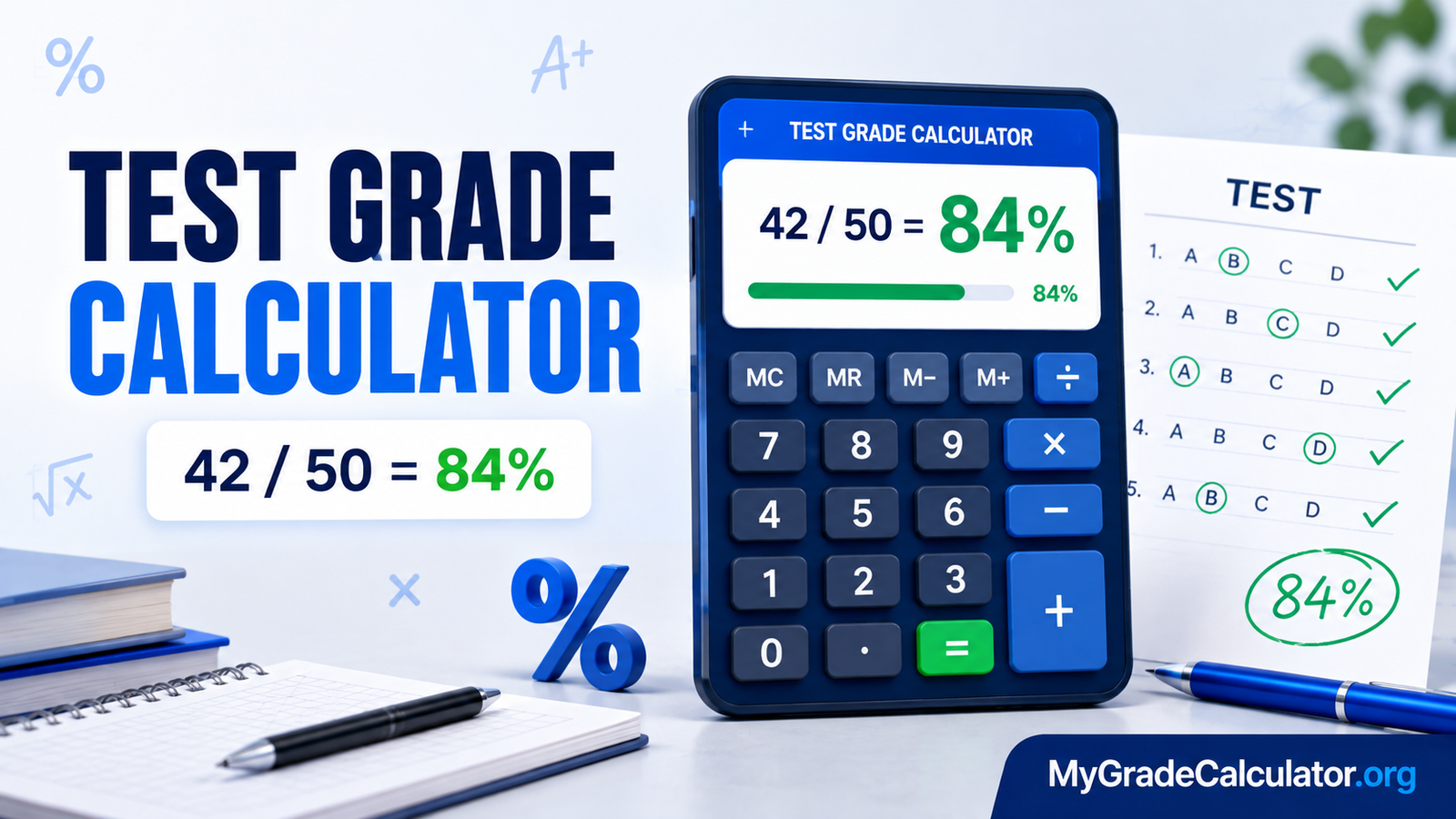
A test grade calculator helps you quickly determine your test percentage from the points you earned and the total points possible. The basic formula is simple:
Test Grade Percentage = (Points Earned ÷ Total Points Possible) × 100
For example, if you score 42 out of 50 points, your test grade is 84%. The letter grade depends on the grading scale used by your school, teacher, or college.
Test Grade Calculator
A test grade calculator makes it easy to convert your raw test score into a percentage. Instead of calculating the result manually, enter the points you earned and the maximum points available.
For example:
| Points Earned | Points Possible | Test Grade |
| 45 | 50 | 90% |
| 42 | 50 | 84% |
| 38 | 50 | 76% |
| 27 | 30 | 90% |
| 68 | 80 | 85% |
| 72 | 100 | 72% |
The calculation tells you how well you performed on the test. If you also want to know how the test affects your overall course grade, you need to consider the test’s weight or the total-points grading system used in your class.
What Is a Test Grade Calculator?
A test grade calculator is an academic tool that converts a test score into a percentage or helps determine the corresponding letter grade.
It is especially useful when your test is graded using points. You only need to know:
- Points you earned
- Total points possible
- Your course’s grading scale, if you want to determine a letter grade
For example, if you received 36 points on a test worth 40 points:
36 ÷ 40 × 100 = 90%
Your test percentage is 90%.
The calculator does not change the grading rules established by your school. It simply performs the mathematical calculation based on the information you provide.
How to Calculate a Test Grade
Calculating a test percentage is straightforward.
Step 1: Find Your Score
First, determine how many points you earned.
For example:
Points earned = 44
Step 2: Find the Maximum Score
Next, identify the total number of points available.
For example:
Total points possible = 50
Step 3: Divide Your Score by the Maximum Score
Calculate:
44 ÷ 50 = 0.88
Step 4: Convert the Decimal to a Percentage
Multiply the result by 100:
0.88 × 100 = 88%
Therefore, your test grade is:
88%
Step 5: Determine the Letter Grade
Compare your percentage with your teacher’s or school’s grading scale.
For example, if your class considers 87%–89% a B+, then 88% would be a B+. Another school may use different boundaries.
Always use the grading scale provided for your specific class.
Test Grade Formula
The standard formula for a points-based test is:
Test Grade Percentage = (Points Earned ÷ Total Points Possible) × 100
What Each Part Means
Points Earned: The number of points you received.
Total Points Possible: The maximum number of points available on the test.
100: Converts the decimal result into a percentage.
Example
Suppose you earned 47 points out of 60.
Use the formula:
(47 ÷ 60) × 100
First:
47 ÷ 60 = 0.7833
Then:
0.7833 × 100 = 78.33%
Your test grade is approximately 78.33%.
How to Use a Test Grade Calculator
Using a test grade calculator usually takes only a few seconds.
1. Enter Your Points Earned
Enter the number of points you received on the test.
For example:
72
2. Enter the Total Points
Enter the maximum number of points available.
For example:
80
3. Calculate Your Percentage
The calculation is:
72 ÷ 80 × 100 = 90%
Your test percentage is 90%.
4. Check Your Letter Grade
If the calculator includes a grading-scale option, use the scale that applies to your class.
Remember that percentage-to-letter-grade conversions can differ between schools and courses.
Test Grade Calculator by Points
A points-based grading system is one of the easiest ways to calculate a test percentage.
Suppose a test is worth 75 points and you earn 63 points.
63 ÷ 75 × 100 = 84%
Your test grade is 84%.
The total number of points does not have to be 100. A test worth 20, 50, 75, or 150 points can all be converted into a percentage using the same formula.
More Examples
| Score | Calculation | Percentage |
| 18/20 | 18 ÷ 20 × 100 | 90% |
| 24/30 | 24 ÷ 30 × 100 | 80% |
| 32/40 | 32 ÷ 40 × 100 | 80% |
| 42/50 | 42 ÷ 50 × 100 | 84% |
| 63/75 | 63 ÷ 75 × 100 | 84% |
| 72/80 | 72 ÷ 80 × 100 | 90% |
| 91/100 | 91 ÷ 100 × 100 | 91% |
This shows why the total number of points matters. A score of 42 points could represent very different percentages depending on the maximum score.
How to Calculate a Test Grade From Questions
If every question has the same value, you can calculate your percentage using the number of correct answers.
For example, suppose a test contains 50 questions and you answer 43 correctly.
43 ÷ 50 × 100 = 86%
Your test grade is 86%.
However, this method should only be used when each question has equal value.
What If Questions Have Different Point Values?
Suppose a test contains multiple-choice questions worth 1 point, short-answer questions worth 3 points, and an essay worth 10 points.
In this situation, simply counting correct questions may not produce the correct percentage.
Instead, use:
Points Earned ÷ Total Points Possible × 100
For example:
72 ÷ 85 × 100 = 84.71%
Your test percentage is approximately 84.71%.
Test Grade Percentage Examples
Understanding common score conversions can make test results easier to interpret.
What Grade Is 18 Out of 20?
18 ÷ 20 × 100 = 90%
So, 18 out of 20 is 90%.
What Grade Is 35 Out of 40?
35 ÷ 40 × 100 = 87.5%
So, 35 out of 40 is 87.5%.
What Grade Is 45 Out of 50?
45 ÷ 50 × 100 = 90%
So, 45 out of 50 is 90%.
What Grade Is 70 Out of 100?
70 ÷ 100 × 100 = 70%
So, 70 out of 100 is 70%.
The percentage is mathematically fixed, but the letter grade may vary depending on the grading scale.
Test Grade vs. Overall Grade
Your test grade is not necessarily the same as your overall course grade.
A test grade measures your performance on one assessment.
An overall course grade combines multiple components, such as:
- Assignments
- Quizzes
- Tests
- Projects
- Midterm exams
- Final exams
- Participation
- Other graded work
For example, you might earn:
92% on assignments
85% on quizzes
88% on tests
Your overall grade cannot be determined simply by adding these percentages together. You need to know whether your course uses equal weighting, category weighting, or a total-points system.
How a Test Affects Your Overall Grade
The impact of a test depends on how your teacher calculates the course grade.
Suppose your test score is 90% and the test is worth 20% of the course grade.
The test contributes:
90% × 20% = 18 percentage points
If the other completed categories contribute 67 percentage points, your combined result would be:
67 + 18 = 85%
This is an example of a weighted grading system.
However, not every course calculates grades this way. Some classes use total points instead.
Always check your syllabus or grading policy before estimating your final course grade.
Test Grade Calculator With Weights
A weighted test grade calculation considers how much the test contributes to the overall course.
For example:
| Category | Grade | Weight |
| Assignments | 90% | 20% |
| Quizzes | 85% | 15% |
| Tests | 88% | 40% |
| Final Exam | 92% | 25% |
A weighted system, multiply each grade by its decimal weight and then add the results.
For the tests:
88% × 0.40 = 35.2%
For assignments:
90% × 0.20 = 18%
For quizzes:
85% × 0.15 = 12.75%
For the final exam:
92% × 0.25 = 23%
Then:
18 + 12.75 + 35.2 + 23 = 88.95%
The estimated overall grade is 88.95%, assuming these categories and weights represent the entire course.
Test Grade Calculator for College
College students can use a test grade calculator to convert raw scores into percentages and evaluate their performance.
For example, a college student who receives 74 out of 90 points can calculate:
74 ÷ 90 × 100 = 82.22%
However, the effect of that score on the course grade depends on the professor’s grading structure.
Some college courses use:
- Total points
- Weighted categories
- Percentage-based grading
- Separate exam categories
- Plus/minus grading
- Other instructor-defined systems
Because grading policies vary, use the rules for your specific course when calculating your overall grade.
Test Grade Calculator for High School
High school students can also use a test grade calculator to convert test scores into percentages.
For example, if you score 48 out of 60:
48 ÷ 60 × 100 = 80%
Your test percentage is 80%.
If your school uses a standard letter-grade scale, you can compare that percentage with the appropriate grade boundary.
But do not assume that every school uses identical grading cutoffs. Your teacher’s grading policy should be the final authority.
Test Grade and Letter Grades
After calculating your test percentage, you may want to know its letter-grade equivalent.
A commonly used example of a grading scale might look like this:
| Percentage | Example Letter Grade |
| 90–100% | A |
| 80–89% | B |
| 70–79% | C |
| 60–69% | D |
| Below 60% | F |
This table is only an example. Schools, colleges, teachers, and individual courses may use different boundaries, including plus and minus grades.
For instance, one grading scale might divide the B range into B+, B, and B-, while another may not.
Always check your official course grading scale.
Common Test Grade Calculation Mistakes
Even though the formula is simple, students sometimes make mistakes when calculating their grades.
Dividing by the Wrong Number
Always divide your points earned by the total points possible.
For example, if you earned 42 out of 50:
42 ÷ 50 = 0.84
Do not divide 42 by the number of points you missed.
Forgetting to Multiply by 100
If you calculate:
42 ÷ 50 = 0.84
you still need to convert the decimal into a percentage:
0.84 × 100 = 84%
Confusing Points With Percentages
A score of 42 does not automatically mean 42%.
If the test is worth 50 points, 42 points represents:
84%
Using the Number of Questions Incorrectly
Counting correct answers works only when every question has the same value.
If questions have different point values, calculate the grade using points.
Assuming Every Grading Scale Is Identical
A percentage does not always correspond to the same letter grade everywhere.
Check your school’s or instructor’s grading scale.
Ignoring Test Weight
A 90% test score does not automatically make your overall grade 90%.
The test’s weight and your other grades also matter.
Rounding Too Early
Keep the full calculation until the final step when possible.
For example:
73 ÷ 85 × 100 = 85.882…%
You can round the final answer to 85.88% or 85.9%, depending on your teacher’s instructions.
When Should You Use a Test Grade Calculator?
A test grade calculator is useful whenever you need to quickly understand a test score.
Students can use it to:
- Convert points into a percentage
- Check a manually calculated grade
- Understand test performance
- Compare scores from different tests
- Estimate how a test affects a course grade
- Plan for upcoming exams
- Determine whether a target percentage was reached
Teachers can also use similar calculations to verify grades, prepare score reports, or quickly convert point totals into percentages.
Related Grade Calculators
A test grade calculator focuses on an individual test, but other academic calculations may require different tools.
Grade Calculator
A grade calculator can combine several scores to estimate an overall course grade.
Final Grade Calculator
A final grade calculator can help determine the score needed on a remaining final exam to reach a desired course grade.
Weighted Grade Calculator
A weighted grade calculator is useful when different assignments or categories have different percentages of the final grade.
GPA Calculator
A GPA calculator is designed to estimate grade point averages from course grades and credit information.
Assignment Grade Calculator
An assignment grade calculator can convert individual assignment scores into percentages or help determine their contribution to a course grade.
Choosing the appropriate calculator helps ensure that you are using the correct formula for your grading system.
How to Improve Your Test Grade
Calculating your test score is useful, but the result can also help you identify areas for improvement.
Review Incorrect Answers
Look at the questions you missed and determine why you lost points.
Was the problem caused by:
- A calculation error?
- Lack of understanding?
- Misreading the question?
- Forgetting a concept?
- Running out of time?
Identifying the cause can make your next study session more effective.
Focus on Weak Topics
If several incorrect answers involve the same topic, prioritize that subject when studying.
Practice Under Test Conditions
Practice questions can help you become more comfortable with the format and time limits of an upcoming assessment.
Track Your Scores
Keeping a record of test percentages can help you see whether your performance is improving over time.
Frequently Asked Questions
How do you calculate a test grade?
Divide the points you earned by the total points possible and multiply the result by 100.
Example:
45 ÷ 50 × 100 = 90%
Therefore, 45 out of 50 is 90%.
What is the formula for a test grade?
The standard formula is:
Test Grade = (Points Earned ÷ Total Points Possible) × 100
This formula is appropriate for a straightforward points-based grading system.
What grade is 40 out of 50?
40 out of 50 is 80%.
40 ÷ 50 × 100 = 80%
The letter grade depends on your school’s grading scale.
What grade is 17 out of 20?
17 out of 20 is 85%.
17 ÷ 20 × 100 = 85%
Check your course grading scale to determine the letter grade.
Can I use a test grade calculator for college?
Yes. College students can use a test grade calculator to convert points into percentages. However, the test’s impact on the overall course grade depends on the specific grading system used by the professor.
Conclusion
A test grade calculator provides a quick way to turn a raw test score into an understandable percentage. For a standard points-based test, simply divide the points earned by the total points possible and multiply by 100.
For example:
42 ÷ 50 × 100 = 84%
The calculation is simple, but understanding how the result fits into your overall academic performance requires additional information. If your test is weighted, you need to consider its contribution to the course grade. If you want to determine the letter grade, use the grading scale provided by your instructor or school.
Whether you are checking a recent exam, preparing for your next test, or planning your overall course performance, calculating your test percentage gives you a clear starting point for understanding your academic progress.